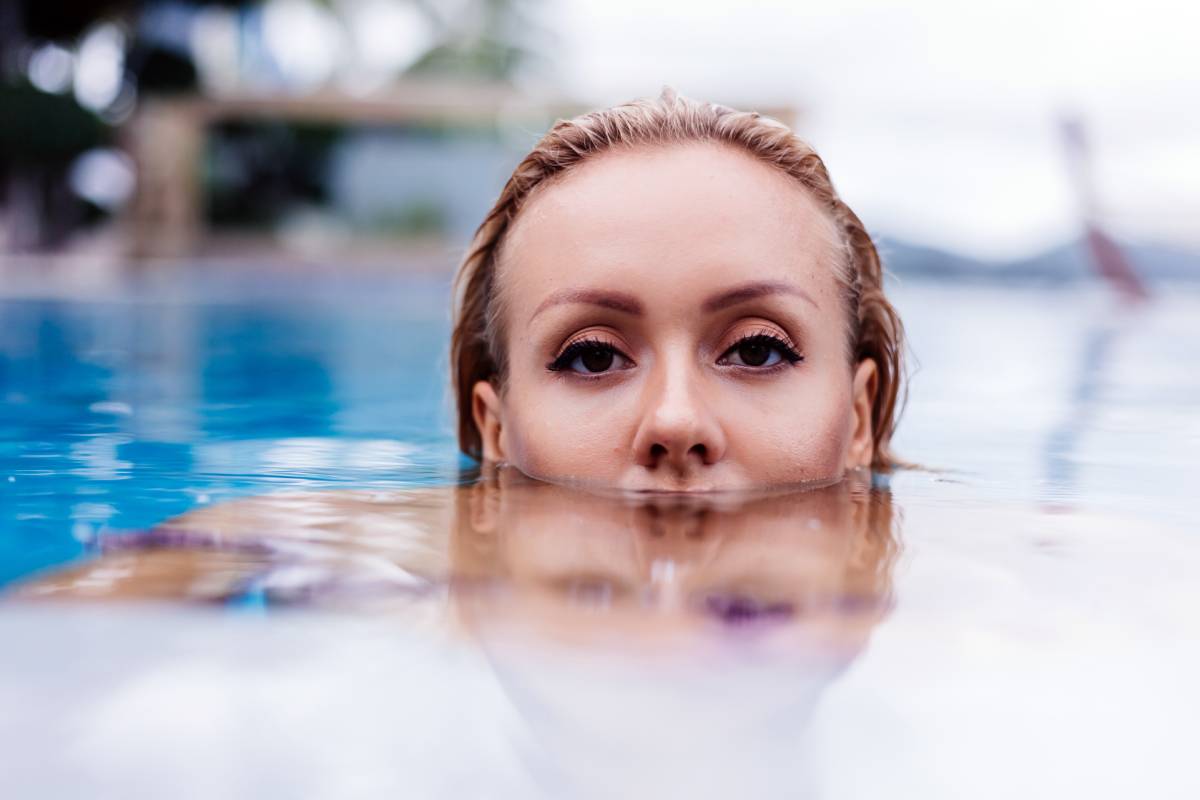
If your eyes are red, burning, and blurry after a swim, you’ve experienced what most people chalk up to “too much chlorine.” But the real story of how chlorine affects your eyes in a swimming pool is more nuanced — and more important for your long-term eye health — than most people realize.
Chlorine isn’t the only culprit. The interaction between pool chemicals, your natural tear film, contact lenses, bacteria, and UV exposure creates a combination that can genuinely damage your eyes over time if you’re not taking the right precautions.
Here’s what’s actually happening to your eyes every time you swim — and what you can do to protect them.
What Chlorine Does to Your Eyes in a Swimming Pool
Chlorine is added to pools to kill harmful bacteria, algae, and other pathogens. It does that job well. The problem is that chlorine doesn’t distinguish between pool contaminants and the natural protective film on your eyes.
Your tear film is a three-layer structure — an oil layer, a watery layer, and a mucin layer
— that keeps the surface of your eye lubricated, smooth, and protected from the environment. When chlorinated water contacts your eyes, it disrupts this film, stripping away moisture and leaving the corneal surface exposed and vulnerable.
The result? Burning, redness, grittiness, and blurry vision that can linger long after you’ve left the pool.
What actually causes the burning isn’t just chlorine itself. When chlorine reacts with sweat, urine, and organic compounds in the pool water, it produces chemical byproducts called chloramines — particularly trichloramine and dichloramine. These compounds are significantly more irritating to eyes than free chlorine alone. A pool that smells strongly of chlorine is actually a sign of high chloramine levels, not necessarily high chlorine levels. Heavy chloramine buildup indicates the water has been heavily used and inadequately refreshed.
Why Your Eyes Turn Red After Swimming
Red eyes after swimming are the most common complaint — and also the most misunderstood. The redness comes from the dilation of blood vessels on the surface of the eye, triggered by irritation from pool chemicals.
Specifically:
- Chloramines irritate the conjunctiva, the thin membrane covering the white of the eye and the inner eyelids, causing inflammation and visible redne
- Tear film disruption forces your eyes into a dry, unprotected state, which amplifies the irritation response.
- Low pH pool water — meaning water that is more acidic than your eyes’ natural pH— can cause a stinging, burning reaction even before chloramine exposure.
For most people, this redness clears within an hour or two after swimming. If redness persists beyond a day, or is accompanied by discharge, significant pain, or vision changes, that is no longer a chlorine reaction — it may be an infection or corneal issue that needs prompt professional attention.
The Tear Film Problem: Why Chlorine Causes Dry Eye
The connection between swimming pools and dry eye is underappreciated. Chlorinated water actively disrupts the lipid (oil) layer of the tear film, causing tears to evaporate faster than normal. Even a brief swim can leave the eye’s surface noticeably drier for hours afterward.
For people who already have dry eye disease, swimming in a chlorinated pool can significantly worsen their symptoms. If you regularly experience gritty, burning, or fatigued eyes after pool sessions that take longer than usual to resolve, your tear film may be chronically compromised — which is worth evaluating with an eye care professional.
The fix after swimming: Rinsing your eyes with clean, fresh water after exiting the pool removes residual chlorine and pool chemicals. Following that with preservative-free artificial tears helps restore moisture to the corneal surface and speeds up tear film recovery. This two-step routine is one of the simplest and most effective things swimmers can do for their eyes.
Swimming with Contact Lenses: A Serious Risk
This is where pool eye health moves from irritation into genuine medical risk.
Contact lenses should not be worn in any body of water — pools, lakes, oceans, hot tubs, or showers. This applies to all lens types, including soft daily disposables.
The reason is specific and serious. Water — including treated pool water — contains microorganisms that contact lenses can trap directly against the surface of your cornea, bypassing your eye’s natural defense mechanisms.
The most serious risk is Acanthamoeba keratitis, a rare but potentially blinding eye infection caused by a microscopic amoeba found in natural and treated water sources. When Acanthamoeba is trapped between a contact lens and the cornea, it can burrow into the corneal tissue, cause ulcers, and — if not caught early and treated aggressively — result in permanent vision loss. This infection is almost exclusively a risk for contact lens wearers.
Beyond this, pool water can cause soft contact lenses to:
- Absorb chlorine and chemicals, concentrating them against the corneal surface
- Change shape due to osmotic differences between pool water and the lens, causing discomfort and poor fit
- Trap bacteria and other pathogens that survive in pool water despite chlorination
If you need vision correction for swimming, prescription swim goggles are the right solution. They provide optical correction, create an air-filled gap in front of the eye that allows normal vision, and seal out pool water entirely. Contact lenses paired with goggles is an option some swimmers use, but it still carries risk — goggles can leak, and even brief water contact with a lens can introduce contamination.
If you did swim with contact lenses accidentally or by choice, remove them immediately after exiting the water, rinse your eyes with sterile preservative-free drops, and replace them with a fresh pair. Never sleep in lenses worn during water exposure.
How to Choose Swim Goggles That Actually Protect Your Eyes
Goggles are the most effective tool for protecting your eyes in a pool, but not all goggles are equal. Here’s what to look for:
| Feature | Why It Matters |
|---|---|
| Leak-proof seal | Keeps pool water from contacting the eye entirely |
| Anti-fog coating | Maintains clear vision throughout your swim |
| UV protection | Important for outdoor pools and open-water swimming |
| Shatterproof lenses | Safety standard for any athletic eyewear |
| Prescription option | Allows correction of myopia, hyperopia, or astigmatism |
| Polarized lenses | Reduces glare on the water surface — ideal for open water |
| Low-profile frame | Better for competitive swimmers and lap swimmers |
| Wide peripheral lens | Better for recreational swimmers and water polo |
If you have a refractive error — nearsightedness, farsightedness, or astigmatism — prescription swim goggles are worth the investment. Light behaves differently underwater than in air, which distorts vision further for those who already have refractive errors. A properly fitted pair of prescription goggles solves both problems at once.
Ask your optometrist about prescription goggle options at your next exam. Alternatively, custom-fit or stock-prescription swim goggles are available in a wide range of powers.
Natural Water vs. Pool Water: Is One Safer?
Many swimmers assume that natural bodies of water — lakes, rivers, the ocean — are gentler on the eyes because they lack chlorine. That assumption is only partially correct.
Natural water doesn’t contain chlorine, but it does contain bacteria, algae, sediment, and in some cases agricultural run offor sewage contamination. Exposure to natural water carries a higher risk of bacterial eye infections than a properly maintained pool,
particularly in warm months when pathogen counts rise. Acanthamoeba it self is common in freshwater lakes and rivers. Saltwater from the ocean is generally less hospitable to bacteria, but it contains salt concentrations that cause osmotic stress on the eye surface and can be significantly irritating.
A properly maintained pool with correct pH balance (7.2–7.8) and appropriate chlorine levels (1–3 ppm) is safer than natural water from an infection standpoint. The irritation from chlorine is real but manageable with the right protective measures. A poorly maintained pool with high chloramine levels or unbalanced pH is the worst of both worlds — chemical irritation without adequate pathogen control.
The bottom line: goggles protect your eyes in any water environment. The type of water changes the nature of the risk, but the solution is the same.
What to Do After Swimming: A Step-by-Step Eye Care Routine
Taking a few minutes after every swim goes a long way toward protecting your eye health over an entire season.
- Rinse your face and eyes with clean, fresh water immediately after exiting the pool. This physically removes residual chlorine and chloramine compounds from the eye surface and surrounding ski
- Use preservative-free artificial tears to restore moisture to the tear fil One or two drops in each eye helps flush any remaining irritants and restores lubrication faster than your eyes can recover on their own.
- If you wore contacts, remove them immediately — don’t wait until you get home. Carry a spare pair and a small bottle of sterile saline or artificial tears in your swim bag.
- Avoid rubbing your eye Post-swim irritation makes rubbing tempting, but it can introduce bacteria from your hands and further damage an already disrupted tear film.
- Wear UV-protective sunglasses if you’re remaining outdoors after swimming. The combination of chemical irritation from pool water and UV exposure from the sunamplifies long-term eye stress.
When Pool-Related Eye Symptoms Require a Doctor
Most chlorine-related eye irritation resolves within a few hours of leaving the pool. But certain symptoms should prompt you to contact an eye care professional rather than waiting it out.
See an optometrist if you experience:
- Redness, pain, or burning that does not improve within 24 hours after swimming
- Yellow or green discharge from the eye
- Significant swelling of the eyelid or tissue around the eye
- Sudden or worsening blurry vision
- Light sensitivity that is new or more severe than usual
- The sensation of something stuck in your eye that doesn’t resolve with rinsing
- Any of these symptoms after swimming with contact lenses
These could indicate a bacterial or Acanthamoeba infection, corneal abrasion, or another condition that requires treatment. Early intervention matters — bacterial eye infections treated promptly resolve fully, while infections caught late can cause permanent corneal scarring.
At Eyes On Group, we provide emergency and urgent eye care for patients experiencing pool-related eye problems across our locations in Worcester and Randolph, MA, and Lincoln and Cranston, RI.
Protecting Your Eyes All Summer
Swimming is one of the best ways to stay active and cool during the summer months.
The goal isn’t to avoid the pool — it’s to go in equipped.
Properly fitted goggles, a solid post-swim rinse routine, and the discipline to leave contact lenses on dry land are all it takes to protect your eyes through an entire season of
swimming. And if you’re overdue for an eye exam, summer is a good time to schedule one — your optometrist can check your tear film health, assess any chronic dry eye issues, and help you find the right prescription goggles or specialty eyewear for water activities.
Conclusion
Chlorine in swimming pool water doesn’t just cause temporary redness — it disrupts your tear film, concentrates irritating chemical byproducts against your eye surface, and creates conditions that can lead to infection if contact lenses are involved.
Understanding what’s actually happening at the chemical level helps you take the right protective measures rather than just rinsing and hoping for the best. Goggles, preservative-free artificial tears, and keeping contacts out of the water are the three non-negotiables. If you’re experiencing persistent irritation, blurred vision, or discharge after swimming, don’t wait — contact an eye care professional.
FEATURED SNIPPETANSWER
How does chlorine affect your eyes in a swimming pool?
Chlorine strips the tear film from the eye’s surface, causing dryness, redness, and blurred vision. When chlorine reacts with organic compounds in pool water, it produces chloramines — chemical byproducts that are more irritating than chlorine alone. These effects are temporary for most swimmers but can cause lasting damage when combined with contact lens wear.
(57 words — optimized for featured snippet)
KEY TAKEAWAYS
- The burning and redness from pool water is primarily caused by chloramines — byproducts of chlorine reacting with sweat and organic matter — not pure chlorine itself.
- Chlorine disrupts the eye’s tear film, causing post-swim dryness that can last for hours; preservative-free artificial tears help restore moisture faste
- Contact lenses should never be worn in any body of water — the risk of Acanthamoeba keratitis, a potentially blinding infection, is real and specific to lens we are
- Prescription swim goggles provide both optical correction and full protection from pool water — they are the safest solution for swimmers with refractive e
- A strong pool chlorine smell indicates high chloramine levels, not necessarily high chlorine — it’s a sign the water has been heavily used.
- Red eyes that persist beyond 24 hours, produce discharge, or are accompanied by pain after swimming should be evaluated by an eye care professional prompt
- Rinsing with fresh water immediately after swimming and following with preservative-free artificial tears is the most effective post-swim eye care routine.
- Natural water (lakes, rivers) is not safer than properly maintained pool water — it carries a higher bacterial load and its own Acanthamoeba risk.
FAQs
Q1: Why do my eyes burn after swimming in a chlorinated pool?
The burning sensation comes primarily from chloramines — chemical compounds formed when chlorine reacts with sweat, urine, and organic material in pool water. These byproducts are significantly more irritating than free chlorine. They disrupt the tear film on your eye’s surface, causing burning, redness, and temporary blurred vision. Rinsing with fresh water and using preservative-free artificial tears after swimming helps speed recovery.
Q2: Is it safe to open your eyes underwater in a swimming pool?
Opening your eyes underwater in a chlorinated pool exposes your corneal surface directly to chloramines and other pool chemicals, which strip away your tear film and cause irritation. It is generally safe to do briefly, but it is not advisable as a regular habit. Swim goggles are the correct solution for underwater visibility — they maintain an air pocket in front of the eyes and eliminate direct water contact entirely.
Q3: Can swimming with contact lenses cause an eye infection?
Yes, and the risk is serious. Contact lenses trap microorganisms — including Acanthamoeba — against the corneal surface, bypassing the eye’s natural defenses. Acanthamoeba keratitis can cause corneal ulcers and permanent vision loss. This infection is almost exclusively found in contact lens wearers who swim with their lenses in. Contact lenses should be removed before entering any body of water, including pools, lakes, and showers.
Q4: How long does chlorine eye irritation last
For most people, chlorine-related eye redness, burning, and blurriness resolves within one to three hours after leaving the pool— faster if you rinse with fresh water and use lubricating eye drops immediately after swimming. If symptoms persist beyond 24 hours, worsen over time, or are accompanied by discharge or significant pain, you should see an eye care professional, as this may indicate an infection or corneal issue rather than simple chemical irritation.
Q5: What's the difference between pool water and natural water for eye safety?
Pool water treated with appropriate chlorine levels and balanced pH is generally safer from an infection standpoint than natural water such as lakes and rivers, which carry higher bacterial and pathogen loads. However, poorly maintained pools with high chloramine levels can cause more chemical irritation. Natural saltwater is osmotically stressful for the eye surface. Goggles provide the best protection in any water environment
regardless of the source.
Q6: Do swim goggles really protect your eyes from chlorine?
Yes. Swim goggles with a proper seal create an air-filled barrier between pool water and your eyes, preventing direct contact with chlorine and chloramines entirely. This eliminates the primary cause of pool-related eye irritation. For swimmers with refractive errors, prescription swim goggles provide both protection and visual clarity underwater. Proper fit and a leak-proof seal are essential — goggles that leak provide incomplete protection.
Q7: Can swimming in pools cause or worsen dry eye disease?
Yes. Chlorine and pool chemicals disrupt the lipid layer of the tear film, causing tears to evaporate faster than normal. This produces a temporary dry eye state that typically resolves with time and artificial tears. For people who already have chronic dry eye disease, regular pool swimming can worsen their baseline symptoms. If you notice that post-swim eye dryness or irritation is lasting significantly longer than it should, it is worth discussing with your optometrist.
Q8: What should I do if my eyes are still red the day after swimming?
Persistent redness the day after swimming is not typical chlorine irritation — that should resolve within a few hours. Day-after redness may indicate a bacterial infection, viral conjunctivitis, or in contact lens wearers, the beginning of a more serious corneal infection. Do not use over-the-counter redness-relief drops as a substitute for professional evaluation. Contact an eye care provider, especially if redness is accompanied by discharge, pain, swelling, or changes in vision.
Q9: What are the best eye drops to use after swimming?
Preservative-free artificial tears are the best over-the-counter option after swimming. They restore moisture to the tear film without introducing preservative chemicals that can cause additional irritation on an already-stressed eye surface. Use one or two drops in each eye immediately after rinsing with fresh water. Avoid drops marketed as “redness relief” for post-swim use — these work by constricting blood vessels and do not address the underlying tear film disruption.
Q10: Are prescription swim goggles worth it?
For anyone with myopia, hyperopia, or astigmatism who swims regularly, prescription swim goggles are absolutely worth the investment. They provide both optical correction and full protection from pool water — eliminating the need to choose between clear vision and eye safety. Unlike contact lenses under standard goggles, prescription goggles carry no infection risk. Your optometrist can help you find the right prescription and style for your type of swimming.