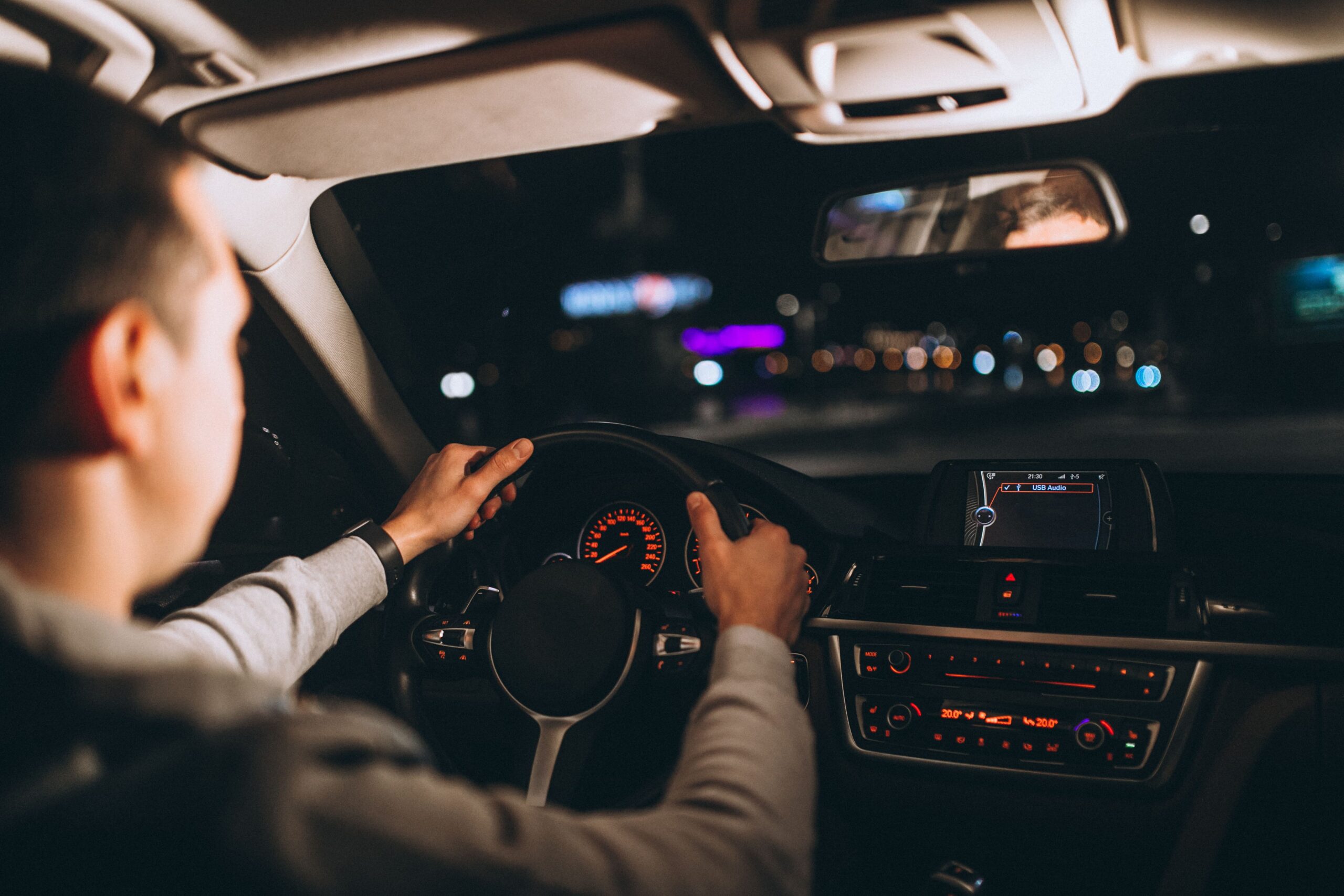
When the clocks fall back, Daylight Saving Time ends, and by Monday morning the drive home from work is suddenly happening in the dark. One week you are pulling into your driveway with an hour of light to spare. The next, you are squinting into a wall of oncoming headlights at 5 p.m.
This is not just a matter of getting used to the season. There are specific things happening inside your eyes that make night driving objectively harder after the clocks change, and most of them can be addressed before the clocks fall back.
Why Night Driving Gets Harder: The Short Answer
Your eyes do not switch instantly from daylight mode to darkness mode. The process, called dark adaptation, takes time. It involves a shift from cone cells (which handle color and detail in bright light) to rod cells (which are responsible for low-light vision). When this system is working well, full dark adaptation takes roughly 20 to 30 minutes.
But several factors can slow it down or make glare from headlights feel more intense than it should. Age is one factor. Refractive errors that have not been corrected, or an outdated prescription, are another. Dry eye plays a role. So does the condition of your lenses, whether you wear contacts or glasses. Any one of these on its own is manageable. When two or three stack up at once, night driving eye strain can feel serious enough to make you avoid driving after dark entirely.
The Science of Dark Adaptation
When light enters your eye, the photoreceptor cells in your retina respond. In bright conditions, your cone cells do most of the work. They detect fine detail and color, but they need adequate light to function well. When light levels drop, your visual system begins transitioning to rod cells, which are far more sensitive in the dark but do not perceive color and take time to become fully active.
The transition involves a chemical process. In low light, your rod cells regenerate a pigment called rhodopsin. This is the mechanism behind dark adaptation, and it takes the full 20 to 30 minutes to reach peak sensitivity. If your eyes are exposed to a sudden bright light during that window (an oncoming car, for example), the rhodopsin breaks down quickly and the process has to restart.
Age affects this directly. By your mid-40s, the pupil does not dilate as wide as it once did in low light, reducing how much light reaches the retina. Rhodopsin regeneration also slows. This is why the same stretch of road that felt comfortable to drive at night in your 30s can feel significantly more demanding at 50. It is a normal part of aging, but it is worth understanding, and in some cases a current prescription and quality optics can help compensate.
Why Glare Gets Worse in Winter
After the clocks change, a combination of conditions works against drivers in New England specifically.
Wet roads. Rain and snow reflect headlights upward toward oncoming drivers, scattering light in ways that dry pavement does not. Worcester, Randolph, Lincoln, and Cranston all see significant precipitation after the clocks fall back, which means your post-clock-change commute frequently involves wet road glare on top of the darkness.
Dirty or fogged windshields. A film of grime on the inside of your windshield, barely noticeable in daylight, scatters headlight beams into distracting halos at night. The same physics applies to dirty eyeglass lenses.
If you notice headlights appearing as starbursts or streaks rather than sharp points of light, that pattern can also indicate uncorrected astigmatism. Astigmatism causes the eye to focus light unevenly, which scatters bright sources into irregular shapes. A current prescription that corrects for astigmatism, combined with anti-reflective lenses, addresses this directly. It is one of the clearest cases where a glasses update makes a practical, daily-life difference.
People who have early cataracts sometimes first notice the problem not in an eye exam room but on a dark road after the clocks change. The clouding of the lens scatters light and increases glare sensitivity. This is worth mentioning to your optometrist if night glare is getting noticeably worse from year to year.
What Glasses and Contact Wearers Need to Know
If you wear corrective lenses, the quality and condition of those lenses has a direct impact on night driving comfort.
Glasses wearers
- Anti-reflective (AR) coating reduces internal lens reflections that compound headlight glare. Without it, your lenses act as partial mirrors in the dark, bouncing light from oncoming cars back toward your eye. The American Optometric Association notes AR coating as one of the most practical upgrades for night drivers.
- An outdated prescription means your eye is working harder to resolve detail, which compounds fatigue on a dark road. If your last exam was more than a year ago and night driving has become uncomfortable, an updated prescription is the first place to look.
- Dirty lenses scatter light the same way a dirty windshield does. Clean lenses before night driving.
Contact lens wearers
- Contacts worn past their replacement schedule or worn for too long in a day cause dryness. Dry eye reduces the quality of the tear film on the front of your eye, which acts as the primary refractive surface. A degraded tear film creates blurring and increases glare sensitivity.
- Wearing glasses for long driving sessions, especially at night, is a reasonable choice if your contacts are causing dryness. A pair of glasses with AR coating specifically for driving is worth discussing with your optometrist.
Dry eye is a bigger contributor to night driving difficulty than most people realize. If your eyes feel scratchy, gritty, or tired by the end of the day, that dryness is affecting your vision in low light. Learn more about Dry Eye Disease and Treatment at Eyes On Group.
When Night Vision Problems Signal Something Worth Checking
Not every night driving difficulty can be fixed with cleaner lenses and an AR coating. Some patterns are worth bringing to an optometrist before the winter sets in.
- Headlights appearing significantly brighter or more blinding than they used to, progressively worse from year to year: this pattern is consistent with early cataract development.
- A halo or starburst pattern around every light source, not just in wet conditions: uncorrected astigmatism is a common cause, but it can also indicate irregular corneal changes.
- Difficulty with peripheral vision at night, or a sense that the field of vision is narrowing: this is worth checking for glaucoma. Early glaucoma often affects peripheral vision before central vision, and the change can go unnoticed until it is significant.
Learn more about Glaucoma Testing and Treatment at Eyes On Group.
The clock change is a reliable annual prompt to schedule a comprehensive eye exam. Most adults should have one every year or two, and if you are driving regularly in the dark for the first time this season, before the clocks change is the right time to go.
Frequently Asked Questions
Why is night driving harder after the clocks change?
The sudden shift to darker commuting hours means your eyes are adapting to low light conditions they were not regularly facing before. Dark adaptation takes 20 to 30 minutes to complete, and many drivers never get that time before they are already on a lit road with oncoming headlights. Add wet roads, seasonal precipitation, and the visual fatigue of a full workday, and the experience of night driving worsens noticeably in the first weeks after the time change.
How can I improve my night vision for driving?
Start with a current prescription. Uncorrected or under-corrected refractive errors amplify the difficulty of low-light vision. If you wear glasses, AR coating makes a practical difference by reducing internal lens reflections. Treating dry eye, if that is a factor, improves tear film quality and reduces blur. Keep windshields and lenses clean. And give your eyes time to adapt before getting on a fast road, if the situation allows.
Do glasses help with night driving?
The right glasses help. An accurate, current prescription corrects the refractive errors that scatter light. Anti-reflective coating reduces glare from oncoming headlights. Glasses marketed specifically as “night driving glasses” with yellow tints do not have strong evidence behind them and can actually reduce contrast sensitivity. Stick with clear AR-coated lenses and an accurate prescription. Browse eyeglass frames and lens options at Eyes On Group.
Why do headlights look like starbursts?
Starburst or spike patterns around light sources are almost always a sign of uncorrected astigmatism. Astigmatism causes light to focus at multiple points rather than one, producing the streak effect. People who already wear astigmatism correction sometimes notice the effect returning when their prescription is outdated or when they are wearing contacts that are no longer fitting correctly. A current prescription check will confirm whether this is the cause.
Can dry eyes affect night driving?
Yes. The tear film on the front surface of the eye is part of your visual optics. When it is degraded by dryness, light scatters more as it enters the eye, contributing to blur and increased glare sensitivity. If you notice that your eyes feel worse in the evening when driving, dryness is worth evaluating. Treatment options include artificial tears, prescription drops, and in some cases in-office procedures. Your optometrist can assess the severity and recommend the right approach.
When should I be worried about night vision problems?
If the difficulty is new and getting worse from year to year, if it comes with halos that are present even in dry conditions, or if you notice any narrowing of peripheral vision at night, those are reasons to book an eye exam rather than wait for your next annual appointment. Cataracts, uncorrected astigmatism, and early glaucoma are all detectable in a standard comprehensive exam.
Before the Clocks Change: A Practical Step
Daylight Saving Time ends twice a year. If the last year of night driving has felt harder than it should, or if you cannot remember the last time you had your eyes examined, now is the right time to act.
Eyes On Group sees patients across four New England locations, in Worcester and Randolph, MA, and in Lincoln and Cranston, RI. A comprehensive eye exam checks for refractive errors, cataracts, glaucoma, and dry eye, and your optometrist can advise on lens options including anti-reflective coatings built for driving. Getting checked before the clocks change means you are not adjusting to a new prescription in the dark.
Book an Appointment Before the Clocks Change
Book an Appointment at Eyes On Group.