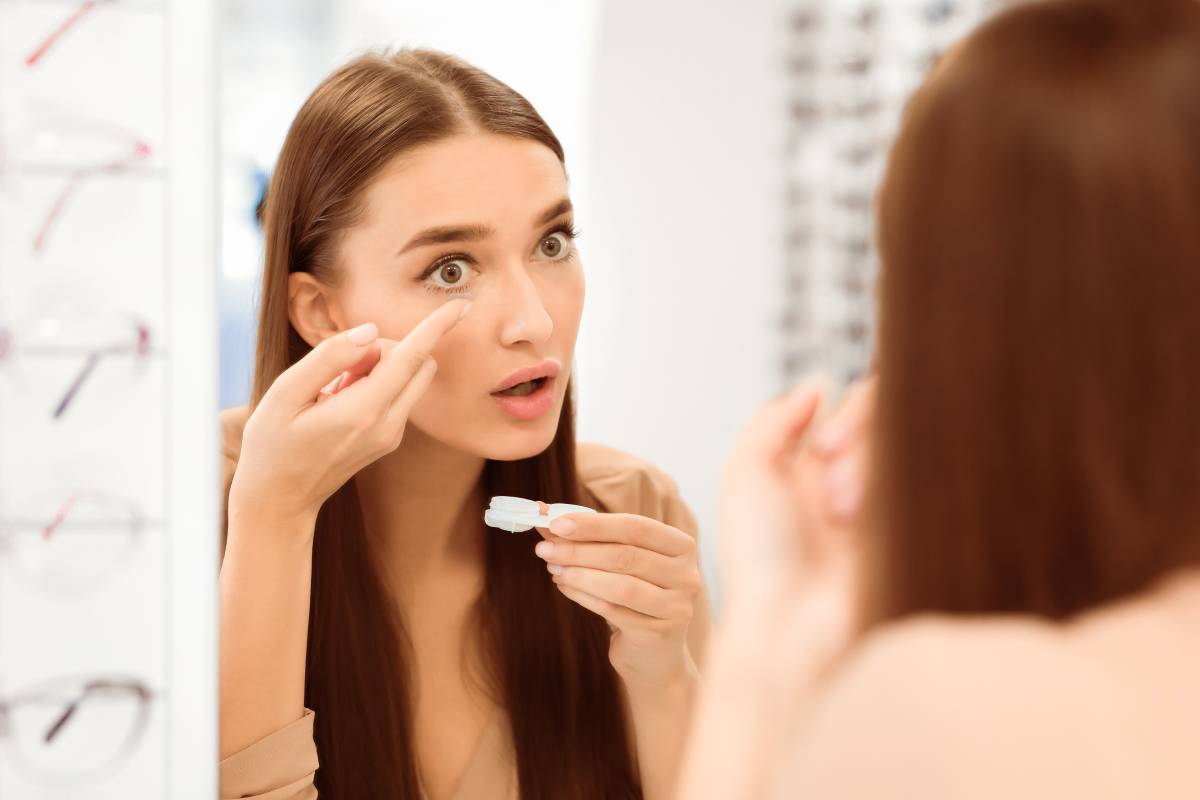
One of the most common questions parents bring to an optometry appointment — often prompted by a teenager sitting next to them in the exam chair — is: what age can kids wear contact lenses?
The honest answer surprises most people: there is no minimum age. There is no federal guideline, no professional consensus on a specific birthday that makes a child ready.
What optometrists actually evaluate is something more nuanced — a combination of physical readiness, demonstrated responsibility, and maturity of motivation. A 10-year-old who takes meticulous care of their braces and follows routines independently may be more ready for contacts than a 16-year-old who regularly forgets their glasses at home. Here’s what actually goes into that decision.
Why There’s No Magic Age Number
The eye it self doesn’t reach a developmental milestone at 13 or 16 that makes contact lens wear suddenly appropriate. Children’s corneas are fully capable of accommodating soft contact lenses well before the teenage years. Research backs this up.
A clinical study tested 294 children aged 7–11 with myopia, fitting each with a different type of daily-wear soft contact lens and monitoring them with eye exams every six months over three years. The conclusion: contact lens wear was just as safe for children in that age range as it was for adult wearers, provided proper supervision was in place. The most common issues occurred in the first year — minor irritation, occasional allergic reactions, adjustment-related discomfort — and declined significantly after that initial period. None of the issues caused lasting harm to vision.
So why do most optometrists and parents default to “wait until they’re older”? Partly tradition, partly caution, and partly the reasonable assumption that hygiene habits improve with age. But tradition and caution are not the same as clinical necessity.
What Optometrists Actually Evaluate Before Fitting a Young Patient
Rather than checking a calendar, optometrists who specialize in pediatric vision consider a set of readiness indicators that together give a reliable picture of whether a child is prepared to wear contacts safely.
Demonstrated Responsibility in Daily Life
Does your child consistently complete tasks without repeated reminders? Do they maintain hygiene routines — brushing teeth, washing hands, keeping track of belongings — with reasonable independence? Contact lens care requires a specific daily sequence: clean hands before insertion, proper removal every evening, correct storage in fresh solution, replacement on schedule. A child who struggles to maintain simpler routines will struggle with this one.
This is not a judgment on the child — it’s a practical assessment of whether the timing is right.
Motivation: Who Wants the Contacts?
This matters more than most parents expect. A child who genuinely wants contacts — because glasses interfere with a sport they love, because they’re self-conscious, because they want more freedom in how they present themselves — will take lens care seriously. A child who is ambivalent, or whose parent is more enthusiastic than they are, is less likely to build the consistent hygiene habits that keep contacts safe.
Optometrists often ask the child directly: why do you want to wear contacts? The answer reveals a lot about the right timing.
Understanding of Hygiene Risks
Contact lenses sit directly on the corneal surface. They can trap bacteria, absorb chemicals, and — if worn in water or slept in accidentally — create conditions for serious eye infections. Children who understand why the hygiene rules exist, rather than just following instructions they don’t connect to consequences, are significantly more likely to comply consistently.
A brief conversation in the exam room often reveals how much a child understands about eye health and what’s at stake.
The Best Type of Contacts for Young Wearers
When an optometrist does decide a child is ready, the lens recommendation is almost always the same starting point: daily disposable soft contact lenses.
Why daily disposables are ideal for new and young wearers:
- Open a fresh pair every morning — no cleaning solution, no storage case, no overnight contamination risk
- Ifa lens is lost, torn, or uncomfortable, there is a fresh one immediately available
- Eliminates the most common source of lens-related problems: inadequate or improper cleaning of reusable lenses
- Lowest long-term infection risk of any contact lens modality
- Simplest routine — reduces the number of steps a young wearer must remember and execute correctly
Monthly or biweekly lenses require daily cleaning, proper storage in fresh solution, and disciplined replacement schedules. They are perfectly appropriate for motivated, organized teens. For a child getting their first experience with contacts, however, daily disposables remove the most failure-prone steps from the equation.
Why Teens with Myopia May Be Especially Good Candidates
Parents of children with myopia — nearsightedness, where close objects are clear but distant ones appear blurry — may be presented with another reason to consider contacts beyond comfort and convenience.
Certain types of contact lenses, specifically multifocal soft lenses and orthokeratology (ortho-k) lenses worn overnight, have been shown in clinical research to slow the progression of myopia in children. This is called myopia control or myopia management, and it’s an active area of pediatric eye care.
The practical implication: if your child has myopia that is progressing — meaning their prescription changes at each annual exam — asking your optometrist about contact lenses as part of a myopia management strategy gives you a functional clinical reason to consider contacts earlier than you might otherwise.
This is a conversation worth having specifically at your child’s next comprehensive eye exam.
How to Know Your Teen Is Actually Ready: A Parent’s Checklist
Use this as a conversation starter with your optometrist, not a definitive pass/fail test.
These are the indicators most commonly evaluated when making a contact lens
| Readiness Indicator | Ready | May Need More Time |
|---|---|---|
| Maintains daily hygiene routines independently | Consistently | Requires frequent reminders |
| Track record with glasses | Keeps them clean, rarely loses them | Often lost, damaged, or forgotten |
| Motivation for contacts | Clearly their own idea and goal | Ambivalent or primarily parent-driven |
| Understanding of hygiene risks | Can explain why lens hygiene matters | Sees rules as arbitrary |
| Reaction to responsibility | Seeks it and responds well | Avoids or resists responsibility |
| Sports or lifestyle need | Genuine practical reason | No specific need beyond peer influence |
| Reaction to the exam discussion | Engaged, asks questions | Disengaged or uncomfortable with the topic |
No child will score perfectly on every indicator. The goal is a balanced picture, not a checklist that disqualifies a ready child on a technicality.
What Contact Lens Care Actually Looks Like for Young Wearers
If you’re a parent who never wore contacts yourself, the care routine may feel uncertain. Here’s what a daily disposable routine — the recommended starting point for young wearers — actually involves.
Every morning:
- Wash hands thoroughly with soap and water, dry completely
- Open a fresh pair of daily disposable lenses
- Insert lenses using clean fingertips — one lens, one eye at a time
During the day:
- Never rinse or store lenses in tap water
- Remove lenses before swimming or any water activity
- Ifa lens feels uncomfortable, remove it rather than forcing through the discomfort
- Never share lenses with anyone
Every evening:
- Wash hands
- Remove lenses — one at a time, gently
- Discard both lenses in the trash (daily disposables are single-use)
What to watch for and report:
- Persistent redness that doesn’t clear after lens removal
- Pain or unusual light sensitivity while wearing lenses
- Blurry vision through a lens that was clear before
- Any discharge or crusting around the eye
The first few days of contact lens wear involve an adjustment period — some awareness of the lens, occasional dryness, getting used to insertion and removal. This is normal.
Symptoms that worsen rather than improve, or that appear suddenly after a period of comfortable wear, are the ones that require attention from an eye care professional.
The Contact Lens Fitting Appointment: What to Expect
Getting contacts isn’t simply filling a glasses prescription into a different format. A contact lens fitting is its own appointment with its own steps.
Your child’s optometrist will:
- Measure the cornea — contact lenses must match the curvature of the eye for proper fit, comfort, and oxygen flow. This measurement is separate from the refractive prescription used for glasses.
- Evaluate tear production — dry eyes affect contact lens comfort. A brief assessment ensures the eye surface can support daily lens wear.
- Select trial lenses — fitting lenses go in at the appointment so the optometrist can observe the fit, centration, and movement on the eye.
- Teach insertion and removal — your child practices removing and reinserting the lenses in the office before taking any home. This is non-negotiable; they leave the appointment able to do it independently.
- Provide care instructions — written and verbal guidance on the specific lens type prescribed, wear schedule, and what symptoms require contact.
- Schedule a follow-up — typically one to two weeks after the initial fitting to confirm the lenses are performing correctly.
This is a more involved appointment than a standard eye exam. Plan accordingly.
When Contacts Are Ready — And When They’re Not Yet
Contacts are a genuinely good option for many children and teens. For athletes, they eliminate the risk of glasses being knocked loose or broken during play. For teens who feel self-conscious, they offer a meaningful quality-of-life improvement that feeds directly into confidence and engagement in school and social settings. For children with myopia management needs, certain lens types may actively benefit their long-term visual health.
They are not the right choice for every child right now. A child who isn’t ready for the responsibility isn’t being held back — they’re being given time to develop the habits that make contacts safe and sustainable. The conversation with your optometrist will give you an honest picture of where your child stands.
At Eyes On Group, we work with children and teens across all of our locations — Worcester and Randolph, MA, and Lincoln and Cranston, RI — to assess contact lens readiness, fit the right lenses for younger wearers, and support both parents and kids through the adjustment period.
Conclusion
What age can kids wear contact lenses? Clinically, there isn’t a fixed answer — children as young as 7 have worn them safely in supervised research settings. What matters far more than age is responsibility, motivation, hygiene understanding, and a proper professional fitting. For most parents, the right time to have the conversation is when their child starts asking for contacts with genuine, sustained interest. That’s the signal worth taking seriously — and the right moment to bring it to an optometrist.
FEATURED SNIPPETANSWER
What age can kids wear contact lenses?
There is no minimum age for contact lenses — children as young as 7 have worn them safely in clinical research. Optometrists evaluate readiness based on responsibility, hygiene habits, and the child’s own motivation rather than age. Daily disposable soft lenses are the recommended starting point for young wearers due to their simpler care routine and lower infection risk.
(57 words — optimized for featured snippet)
KEY TAKEAWAYS
- There is no established minimum age for contact lenses — clinical research shows children as young as 7 can wear soft contact lenses safely with proper supervision.
- Optometrists assess readiness based on demonstrated responsibility, personal motivation, and understanding of hygiene risks — not chronological age.
- Daily disposable soft contact lenses are the recommended starting point for young and first-time wearers because they eliminate the most failure-prone steps of lens care.
- Motivation matters significantly: children who genuinely want contacts take lens hygiene more seriously than those who are ambivalent or whose parents are more interested than they are.
- Teens with progressing myopia may be candidates for contact lenses as part of a myopia management strategy — multifocal soft lenses and ortho-k lenses have clinical evidence supporting their use in slowing myopia progression.
- A contact lens fitting is a separate appointment from an eye exam — it includes corneal measurements, tear film evaluation, trial lens insertion, and hands-on removal practice before any lenses go home.
- Common early adjustment symptoms (lens awareness, mild dryness) are normal. Persistent redness, pain, light sensitivity, or sudden blurry vision through the lens are not normal and require prompt professional attention.
- Children whose hygiene routines, organizational habits, or motivation aren’t fully developed yet aren’t being denied contacts permanently — they’re being given time to build the habits that make contacts safe and sustainable.
FAQs
Q1: What is the minimum age for contact lenses?
There is no official minimum age for contact lenses. The American Optometric Association does not specify a cut off age; instead, readiness is evaluated individually. Clinical studies have shown children as young as 7 can wear soft daily contact lenses safely with adult supervision. The key factors are the child’s maturity, hygiene habits, motivation, and whether they can perform insertion and removal independently.
Q2: What type of contact lenses are best for kids and teens?
Daily disposable soft contact lenses are the most commonly recommended option for young first-time wearers. They require no cleaning solution or storage case — a fresh pair is used each day and discarded each evening. This eliminates the most common source of contact lens problems: inadequate cleaning of reusable lenses. Daily disposables also carry the lowest infection risk of any lens modality, making them the safest starting choice for children.
Q3: How do I know if my child is ready for contact lenses?
The key indicators optometrists look for are: consistent independent hygiene routines, a track record of responsibility with their glasses, genuine personal motivation (not parent-driven), and an ability to explain why lens hygiene matters. A child who handles daily responsibilities without constant reminders and who clearly wants contacts for their own reasons is typically a good candidate. The contact lens fitting appointment includes an optometrist assessment of readiness.
Q4: Can contact lenses help slow myopia progression in kids?
Yes. Certain types of contact lenses — specifically multifocal soft contact lenses and orthokeratology (ortho-k) lenses worn overnight — have clinical evidence supporting their role in slowing myopia progression in children. This is called myopia control or myopia management. If your child’s prescription changes at each annual exam, it’s worth asking your optometrist whether contact lenses as part of a myopia management strategy are appropriate for them.
Q5: What happens at a contact lens fitting for a child or teen?
A contact lens fitting is a separate appointment from a standard eye exam. It includes corneal curvature measurements (to match the lens to the eye’s shape), a tear film evaluation, trial lens fitting and observation, and — importantly — hands-on practice inserting and removing the lenses in the office. Your child will not leave with contacts until they can do this independently. A follow-up appointment is typically scheduled one to two weeks later.
Q6: Are daily disposable contacts safe for young wearers?
Daily disposable contact lenses are considered the safest contact lens modality for young wearers. Because a fresh pair is used each day, there is no risk of contamination from improperly cleaned or stored lenses — which is the leading cause of contact lens-related eye infections. They also eliminate solution compatibility issues and simplify the daily routine, which supports better compliance in younger wearers who are still developing consistent habits.
Q7: What are the risks of contact lenses for children and teens?
The most common risks are eye infections from improper hygiene, discomfort from ill-fitting lenses, and irritation from allergens or solution sensitivity. Research on children aged 7–11 found that most issues occurred in the first year of wear and declined significantly after adjustment. Serious complications are rare when lenses are properly fitted by an optometrist, worn according to schedule, and cared for correctly. Swimming in contacts carries serious infection risk — lenses should always be removed before water activities.
Q8: Should my child wear contacts for sports?
Contact lenses can be a practical choice for active children and teens — they eliminate the risk of glasses being knocked loose or broken during play, provide full peripheral vision without a frame in the way, and are compatible with most sports goggles and protective eyewear. For contact sports and water activities, appropriate protective eyewear should still be worn over contact lenses. Your optometrist can recommend the right combination of correction and protection for your child’s specific sport.
Q9: Can teenagers buy contact lenses without a prescription?
No. In the United States, contact lenses — including non-prescription cosmetic and colored contacts — are classified as medical devices by the FDA and legally require a valid prescription from a licensed eye care professional. Buying lenses without a prescription, including from online sellers or costume shops, is both illegal and dangerous. Improperly fitted lenses can cause corneal abrasion, infection, and in severe cases, permanent vision loss.
Q10: How often does my child need an eye exam if they wear contact lenses?
Children and teens who wear contact lenses should have a comprehensive eye exam every year, and a contact lens-specific follow-up as recommended by their optometrist. Annual exams monitor prescription changes — which tend to occur more rapidly during childhood and adolescence — and assess the health of the cornea and tear film under contact lens wear. If your child’s prescription changes frequently, your optometrist may recommend more frequent visits to monitor progression and adjust the correction accordingly.